Saturday, January 2, 2016


Computers Plus Crowds Could Tackle World's Toughest Problems


34
7
1
Submit
0
Reddit
A person's hand hovers over a futuristic looking computer touch screen
Credit: Sergey Nivens/Shutterstock.com
The world's most dire problems, such as climate change and global conflicts, could be solved using a combination of human and computer intelligence, researchers say.
Human outperform machines at many tasks, such as recognizing images and thinking creatively. So, with the help of computers, crowds of people could collaborate in networks to achieve what neither people nor computers could do alone, a growing field known as human computation.
"What's most exciting to me about human computation is that it gives us hope today," said Pietro Michelucci, director of the Human Computation Institute in Fairfax, Virginia. Although many people have pinned both their hopes on artificial intelligence (AI), or super-intelligent machines, human computation provides an alternate view, he said.

By using today's technology to combine humans and machines, human computation could achieve sooner what AI might achieve only in the distant future, Michelucci said. And, "with the integral involvement of humans in these systems as both participants and stakeholders, we can better ensure that we remain in control," he said.
One notable example of human computation is reCAPTCHA, an online widget used by about 100 million people daily when they transcribe distorted text into a box to prove they are human in order to access online content. This act of transcribing collections of letters has helped power efforts that have digitally transcribed 13 million articles from The New York Times archives.
Most of today's human-computation systems rely on doling out small "micro tasks" to many people and then merging the results together. For instance, 165,000 volunteers in 145 countries have used the EyeWire platform to analyze thousands of images online and help build the world's most complete map of the neurons in the human retina, which is the tissue in the back of the eye that detects light and enables people to see.
However, as effective as micro tasking has proven to be, this strategy alone cannot address so-called "wicked problems" such as climate change and global conflicts, experts said. [10 Technologies That Will Transform Your Life]
A man operates a floating computer touch screen
"Wicked problems are wicked because they have many interacting parts [and] unpredictability, and because we don't understand how the different parts feed back on each other," said Janis Dickinson, professor and director of citizen science at the Cornell Lab of Ornithology in Ithaca, New York. Michelucci and Dickinson analyzed the latest research in human computation in an article published in the Jan. 1 issue of the journal Science.
And trying to solve wicked problems can have unforeseen and unwanted consequences — for instance, giving financial aid to a country after a natural disaster can lead to corruption that can actually stymie relief efforts, the researchers said.
Now scientists are envisioning ways in which human computation might tackle such complex problems.
"The key to addressing wicked problems is to create a working model, [a] computer simulation, of all of the interacting systems that pertain to a given problem," Michelucci told Live Science. "Imagine something like the game SimCity, but a thousand times more detailed. Then link in real-time sensors attached to the Internet. The more faithful the model is to the real world, the more accurate it will be for testing out solutions and predicting outcomes."
Imagine an online system that feeds this working model of the world "with knowledge from real people, where a doctor can input diagnostic methods, a mechanic can describe how a piston works, and farmers in every region of the world can provide local updates about agricultural pests," Michelucci said. "A working model of the world that pristine requires working knowledge that may be spread across the minds of thousands or millions of people, books, electronic documents and data sets."
This strategy for tackling wicked problems requires not only the constant gathering of data from the real world, but also the use of multistep reasoning. Under this method, each problem gets broken down or "decomposed" to many simpler parts that are easier to address.
New human-computation technologies might help make this a reality;  recent techniques allow contributions from people to get processed by a computer and then sent to others for improvement or analysis of a different kind, the researchers noted. [9 Odd Ways Your Tech Devices May Injure You]
For instance, YardMap.org was launched in 2012 to map global conservation efforts one parcel of land at a time, and it allows participants to interact and build on each other's work, something that crowdsourcing alone cannot achieve. Other examples of multistep reasoning were seen in the Polymath Project, which helped prove an 80-year-old mathematical theorem, and the ePluribus Problem Solver, which generated a factually accurate and well-constructed journalistic article based on just a handful of photographs. In both cases, diverse participants worked together to generate solutions.
Creating a working model of the world to handle wicked problems also requires creative thought in order to see how wicked problems might evolve in response to attempted solutions, Michelucci said.
"We can draw on human computation methods for stimulating innovation, eliciting new ideas, spreading them around and giving people the opportunity to build on each other's work," Michelucci said. "Of course, all this has to be fun, easy and quick, so that millions of people actually choose to participate."
A computer is used to create connections within a network.
"The first step might be to elicit broad solution classes from human participants, such as halting climate change or adapting to it," Michelucci said.
"Then, each of those [solution classes] might be further delegated to humans for decomposition — 100 people might receive the task of decomposing 'halt climate change' into two subclasses, such as 'biological solutions' and 'physical solutions.' Each proposal is then sent by the computer to 100 more people who evaluate it on various dimensions.
Then, each of these ideas would be sent out to 100 more people, who might break them down further or propose specific solutions, like 'paint our roofs white to reflect sunlight back into the atmosphere.'
"Ideas would then propagate through the system through various stages of vetting and modification," Michelucci said. At any stage, experts could step in to help explain complex problems in plain English.
Michelucci and Dickinson noted that human computation will need many improvements before it could tackle wicked problems. For example, in most human-computation efforts, only a small number of participants do most of the work, Michelucci and Dickinson said, adding that researchers want to find ways to maximize recruitment and contributions of participants.
"There are many questions about how people behave in human-computation systems that must be resolved before we can think really big about their use in humanitarian efforts or disasters or monitoring and addressing problems arising with chronic environmental change," Dickinson told Live Science. Moreover, Michelucci and Dickinson cautioned that researchers needed to consider what human computation may mean for the labor force, unemployment rates, and the economy, so that people who contribute to human computation projects are protected from exploitation.
But crowdsourced efforts such as Wikipedia and crowdfunding platforms such as Kickstarter highlight the massive potential that human cooperation has for solving problems, Dickinson said.
"There are huge social benefits to cooperation that have largely been overlooked — think of reputation and reciprocation or lack thereof," Dickinson said. "By providing the right kinds of information about our cooperative efforts and where we stand as cooperators, human-computation systems can provide unprecedented support for people to help work on large problems that require large-scale human effort to solve."
Follow Charles Q. Choi on Twitter @cqchoi. Follow us @livescience, Facebook Google+. Original article on Live Science.

Thursday, October 15, 2015

Engineering Facts
Check out our interesting engineering facts and get some cool trivia related to amazing structures, famous landmarks and other impressive engineering achievements.
Learn about different types of engineering such as civil, mechanical, electrical, chemical and aerospace while enjoying all the incredible information related to famous bridges, buildings, dams, trains, tunnels and more.
  • Engineers solve practical problems by applying mathematical and scientific knowledge.
  • The word engineer comes from a Latin word meaning ‘cleverness’.
  • Learn about different types of engineering jobs such as civil, mechanical and electrical with our engineering job facts.
  • As of 2010, the tallest building in the world is the Burj Khalifa in Dubai, UAE. It reaches an incredible 828 metres (2717 feet) in height. Check out more building facts or our list of the tallest buildings in the world.
  • The Great Pyramid of Giza is the oldest of the Ancient Wonders of the World and the last one that remains largely intact. Enjoy more pyramid facts or learn about the Ancient Egyptian pyramids.
  • The building of the Panama Canal, which links the Atlantic and Pacific Oceans, was one of the most difficult engineering projects ever. It is estimated that over 25000 workers lost their lives during the long and dangerous project, with most dying from disease and landslides.
  • Golf balls have dimples because they help reduce drag, this allows the ball to fly further than a smooth ball would.
  • As of 2010, the longest suspension bridge in the world is the Akashi Kaikyo Bridge in Kobe, Japan. Opened in 1998, it spans an amazing 1991 metres (6529 feet). Check out more interesing bridge facts or our list of the longest bridges in the world.
  • Used for water distribution, the Delaware Aqueduct in New York, USA is the longest tunnel in the world (as of 2010). Drilled through solid rock, it reaches a staggering 137 kilometres (85 miles) in length. More tunnel facts.
  • The Hoover Dam, built along the Colorado River between 1931 and 1936 reaches 726 feet in height (221 metres). More interesting dam facts.
  • High speed passenger trains in China reach speeds of up to 350 kph (220 mph).
  • The Titanic was 882 feet (269 metres) long.
  • The London Eye in England is the largest Ferris wheel in Europe, standing at a height of 135 metres (442 feet).
  • The tallest wind turbine in the world has rotor tips that reach over 200 metres (656 feet) above the ground.

Tuesday, October 13, 2015

15 Hot New Technologies That Will Change Everything

         The Next Big thing? The memristor, a microscopic component that can "remember" electrical states even when turned off. It's expected to be far cheaper and faster than flash storage. A theoretical concept since 1971, it has now been built in labs and is already starting to revolutionize everything we know about computing, possibly making flash memory, RAM, and even hard drives obsolete within a decade.
The memristor is just one of the incredible technological advances sending shock waves through the world of computing. Other innovations in the works are more down-to-earth, but they also carry watershed significance. From the technologies that finally make paperless offices a reality to those that deliver wireless power, these advances should make your humble PC a far different beast come the turn of the decade.
In the following sections, we outline the basics of 15 upcoming technologies, with predictions on what may come of them. Some are breathing down our necks; some advances are still just out of reach. And all have to be reckoned with.
                                                              

Monday, October 12, 2015

Rat Brain Reconstructed in a Computer

Saturday, July 25, 2015

 The 350-year-old mystery of why pendulum clocks hanging from the same wall synchronize over time may finally be solved, scientists say.
In 1665, Dutch physicist Christiaan Huygens, inventor of the pendulum clock, was lying in bed with a minor illness and watching two of his clocks hanging on a wall, said Henrique Oliveira, a mathematician at the University of Lisbon and co-author of a new study detailing the findings. Huygens noticed something odd: No matter how the pendulums on these clocks began, within about a  half-hour, they ended up swinging in exactly the opposite direction from each other.

The cause of this effect — what Huygens called an "odd kind of sympathy" — remained a mystery for centuries. But recently, scientists analyzing two pendulum clocks hanging from the same beam found that the clocks could influence each other through small forces exerted on the supporting beam. However, "nobody tested properly the idea of clocks hanging on the same wall," Oliveira told Live Science. [5 of the Most Precise Clocks Ever Made

Friday, July 25, 2014

30 fun facts about engineering, science and technology

1.      220 million tons of old computers and other technological hardware are trashed in the United States each year.
2.      A diamond will not dissolve in acid. The only thing that can destroy it is intense heat.
3.      According to Moore's Law, microchips double in power every 18 to 24 months.
4.      Albert Einstein won the Nobel Prize for physics in 1921.
5.      Although the famous first flight at Kitty Hawk took place on December 17, 1903, the secretive Wright Brothers did not demonstrate the technology to the broader public until August 8, 1908.
6.      As of early 2009, there have been 113 space shuttle flights since the program began in 1981.
7.      Bill Clinton's inauguration in January 1997 was the first to be webcast.
8.      Chuck Yeager blasted through the sound barrier at Edwards Air Force Base in 1947.
9.      Einstein received the Nobel Prize for Physics in 1921 for his explanation of the photoelectric effect, the phenomenon by which electrons are knocked out of matter by electromagnetic radiation such as light.
10.   In 1901, the Spanish engineer Leonar do Torres-Quevedo was responsible for the earliest developments in the remote control with his Telekine that was able to do "mechanical movements at a distance."
11.   In their Miyagi, Japan laboratories, beginning in 1924, Professor Hidetsugu Yagi and his assistant, Shintaro Uda, designed and constructed a sensitive and highly-directional antenna using closely-coupled parasitic elements. The antenna, which is effective in the higher-frequency ranges, has been important for radar, television, and amateur radio.
12.   Marie Curie was the first person to win two Nobel Prizes for Science
13.   No one has received more U.S. patents than Thomas Edison – 1,093 to be exact.
14.   On 11 July 1962, France received the first transatlantic transmission of a TV signal from a twin station in Andover, Maine, USA via the TELSTAR satellite.
15.   On 9 June 1906 the Winnipeg Electric Railway Co. transmitted electric power from the Pinawa generating station on the Winnipeg River to the city of Winnipeg at 60,000 volts. It was the first year-round hydroelectric plant in Manitoba and one of the first to be developed in such a cold climate anywhere in the world.
16.   On December 12, 1901, a radio transmission of the Morse code letter 'S' was broadcast from Poldhu, Cornwall, England, using equipment built by John Ambrose Fleming.
17.   One third of the world population has never made a telephone call.
18.   Samuel Morse, the inventor of the Morse code, was a painter as well. One of his portraits is of the first governor of Arkansas and hangs in the governor’s mansion of that state.
19.   Telecommunications satellites, and other satellites that need to maintain their position above a specific place on the earth, must orbit at 35,786 kilometers and travel in the same direction as the earth's rotation.
20.   The circumference of the earth is about 25,000 miles. Its surface area is about 200,000,000 square miles and it weighs 6,588,000,000,000,000,000,000 tons.
21.   The Ericsson Company first produced cellular phones in 1979.
22.   The first computer mouse was introduced in 1968 by Douglas Engelbart at the Fall Joint Computer Expo in San Francisco.
23.   The first Japanese-language word processor was developed in Tokyo between 1971 and 1978.
24.   The first laser was made in California in 1960.
25.   The first two video games copyrighted in the U.S. were Asteroids and Lunar Lander in 1980.
26.   The Internet is the fastest-growing communications tool ever. It took radio broadcasters 38 years to reach an audience of 50 million, television 13 years, and the Internet just 4 years.
27.   There have been 113 space shuttle flights since the program began in 1981.
28.   Tim Berners-Lee coined the phrase “World Wide Web” in 1990.
29.   U.S. President Bill Clinton's inauguration in January 1997 was the first to be webcast.
30.   Valdemar Poulsen, a Danish engineer, invented an arc converter as a generator of continuous-wave radio signals in 1902.

Wednesday, July 23, 2014

CIVIL ENGINEERING

                                15 Amazing Civil Engineering Feats

THE GREAT PYRAMID AT GIZA


As the only remaining representative of the original Seven Wonders of the World, any discussion of the greatest engineering feats of humanity without its mention would undermine any authority. This structure is at least 5000 years old, with some claiming it to be up to twice that. For more, check out "The Age of the Pyramids" here at Bright Hub Engineering. There are several theories on how it was constructed, but there is no actual proof to push any one theory to the forefront. No matter which theory is eventually accepted, there is no doubt that this is one of the greatest engineering feats of the ancient world.

Great Wall of China

Great Wall of China

The massive scale of the Great Wall of China merits its inclusion on this list of engineering marvels. At just over 5500 miles long it is the longest continuous construction in the entire world. Although claims were made that is the only man-made object that can be seen from space by the naked eye, this is not true. What astronauts thought was the Great Wall was actually a river.
  • Channel Tunnel in France

    Channel Tunnel in France
    The "Chunnel" is a 31.4 mile underwater tunnel that connects France and England. It was first proposed back in 1802 but because the technology was too expensive it had to wait almost another 200 years. When it was completed, the Channel Tunnel had the longest underwater run of any tunnel in existence (over 23.5 miles). For more on the construction of the Euro Tunnel, see "Engineering the Euro Tunnel."
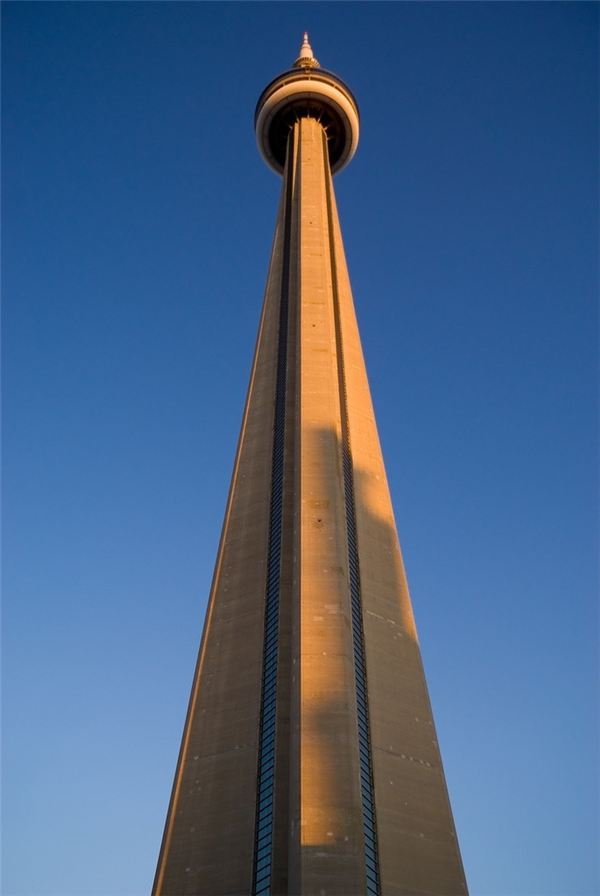
  • CN Tower

    CN Tower
    The CN Tower in Toronto, Canada stands at a breathtaking 1,815.4 ft tall as is currently the tallest free standing structure in the Western Hemisphere. The American Society of Civil Engineers named it one of the modern Seven Wonders of the World. Interestingly enough, the tower was originally designed as a radio antenna without any plans for an observation deck. The main pod wasn't added to the design until much later. For more on this iconic structure, check out "The CN Tower - Enduring Engineering."
    • China's Bird's Nest

      China's Bird's Nest

      The Bird's Nest (Beijing National Stadium) is one of the most recognized of all recent construction projects, as the crowning jewel of the Beijing Olympic Plaza it was beamed into millions of homes for fourteen straight days. The unique design was based on a study of Chinese ceramics and incorporates more structural steel than any other building on the planet (110,000 tons).
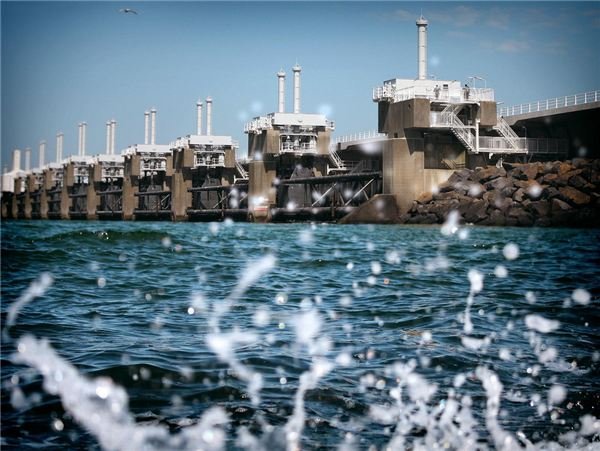
    • Delta Works (Netherlands)

      Delta Works (Netherlands)

      Constructed in several different phases between 1950 and 2010, the Delta Works is a ongoing project that contains a compilation of dams, sluices, locks, dikes, levees, and storm surge barriers that act to protect the coastline of the Netherlands by reducing the amount that is exposed to open seas. It is also on the list of the Seven Wonders of the Modern World as composed by the American Society of Civil Engineers.
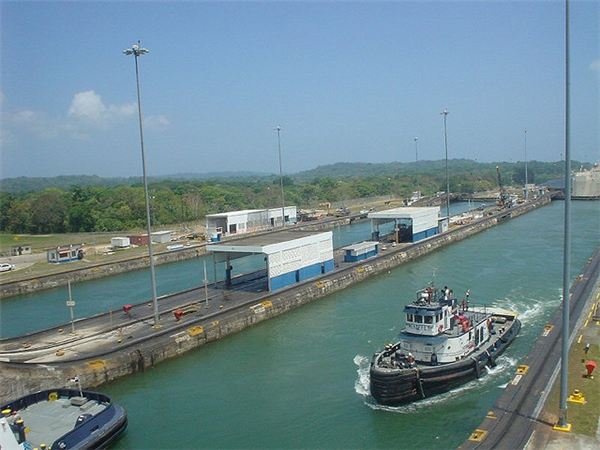
    • Panama Canal

      Panama Canal

      The Panama Canal has long been considered an engineering marvel. First proposed by Charles V, Holy Roman Emperor and King of Spain the 48-mile long man-made canal links the Atlantic Ocean and the Pacific Ocean. When the canal was completed in 1914 it cut 14,000 miles off a trip around Cape Horn. Consisting of several man-made lakes and three locks, the canal is one of the busiest sea ports in the world. Take a full tour of the Panama Canal Transit in Pictures.
    • Golden Gate Bridge

      Golden Gate Bridge

      The Golden Gate Bridge is one of the most elegant structures in the world. Designed by famous Manhattan designer Leon Moisseiff, the 8,981 foot long suspension bridge takes advantage of the "deflection theory" which allows that a small, flexible suspended roadway can flex to compensate for high winds. See "Details of the Golden Gate Bridge" for more specifics. The bridge is the fastest route over San Francisco Bay (before its construction the only way across the bay was by ferry) and an integral part of U.S. Highway 1.
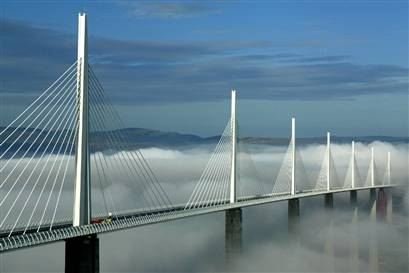
    • The Millau Viaduct

      The Millau Viaduct

      If this isn't a breathtaking view, I'm not sure what is. The Millau Viaduct is the highest bridge in Europe, standing over 890 feet above the ground. It broke several records when it was erected including the highest pylons in the world (803 ft. 8 in.), highest bridge tower in the world (1,125 ft.), and the highest road bridge deck in Europe (890 ft.). Follow the entire construction process at "The Engineering Story of the Millau Viaduct."
    • The Ice Hotel

      The Ice Hotel

      The ice hotel makes this list because it is rebuilt every year in a matter of months, the entire structure is made from ice, and the workers brave temperatures of up to -40 degrees Fahrenheit. Now in its 22nd year, the hotel is located 200 km north of the Arctic Circle in JukkasjÀrvi, Norway. It is just as much an art project as an engineering marvel and should rightfully find its place on this list as the only transient engineering marvel.
    • The International Space Station

      The International Space Station

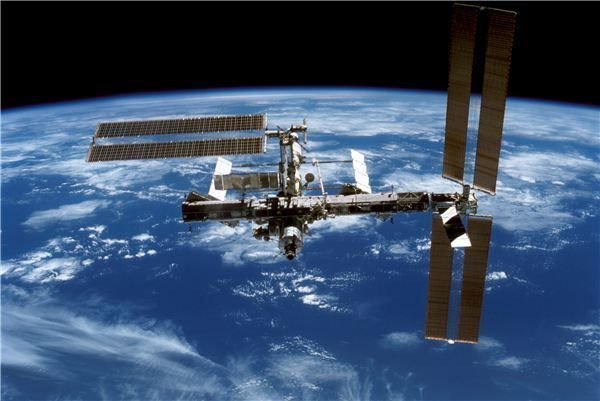
      The international space station is a collaborative engineering marvel. Constructed primarily at ground level facilities and launched into space on rockets or in shuttles, the space station is the only permanent structure to be assembled in space. The assembly logistics are mind boggling as each module had to be dry fitted on Earth so that astronauts in space suits could easily assemble them in the vacuum of space. This might possibly be the greatest achievement in human history to this point.
    • Petronas Towers

      Petronas Towers

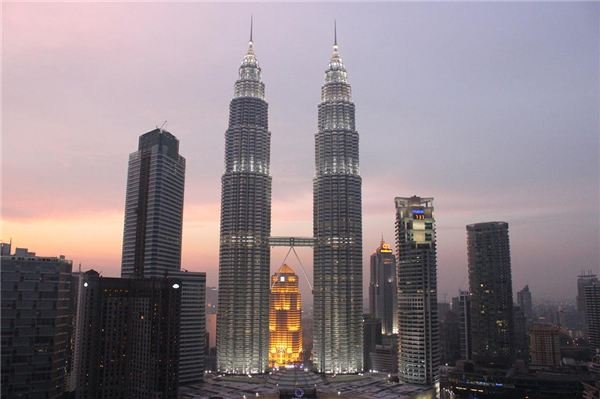
      The Petronas Towers are the tallest twin towers in the world. Located in Kuala Lumpur, Malaysia, the towers stand 1,242 feet tall and consist of 88 floors. The sky bridge located between the 41st and 42nd floors is the highest two-story bridge in the world. Most buildings of extreme height are built with steel skeletons but the cost to import steel into Malaysia made this impractical so the towers were built from concrete (making them twice as heavy and resulting in the need for a double sized base) making them the tallest concrete structures ever built. For more on the construction details see "The Petronas Twin Towers: Construction & How Tall Are They?"
      • Palm Tree Island

        Palm Tree Island

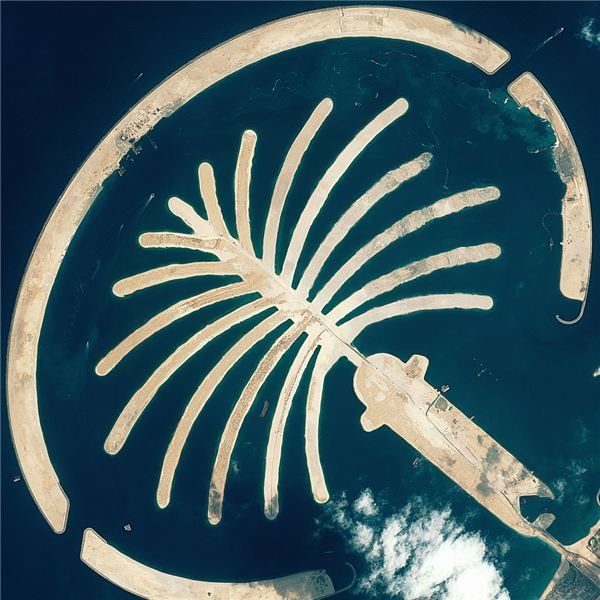
        One of the most ambitious engineering goals of the past century was the construction and development of artificial islands off the coast of Dubai. The palm tree island was created by dredging over 1.1 billion cubic meters of sand and rock from the nearby ocean bottom to create the palm fronds and circular barrier islands. If this proves cost effective, Dubai may build another artificial archipelago, a scale model of the continents of the world. See, "Palm Islands, Dubia: Eight Wonder of the World" for more.
      • Burj-Al-Arab Hotel

        Burj-Al-Arab Hotel

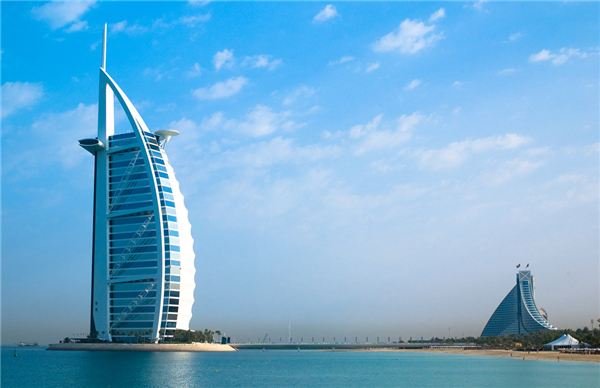
        Although not the tallest or most expensive hotel in the world, the Burj-Al-Arab Hotel in Dubai is an engineering marvel none-the-less. The sail shaped hotel was inspired by the curves of the Sydney Opera House and was meant to be an icon for the country. The interior of the hotel features a grand gallery that stretches up a breathtaking 590 feet. For more on this amazing hotel see "Building the Tallest Hotel."
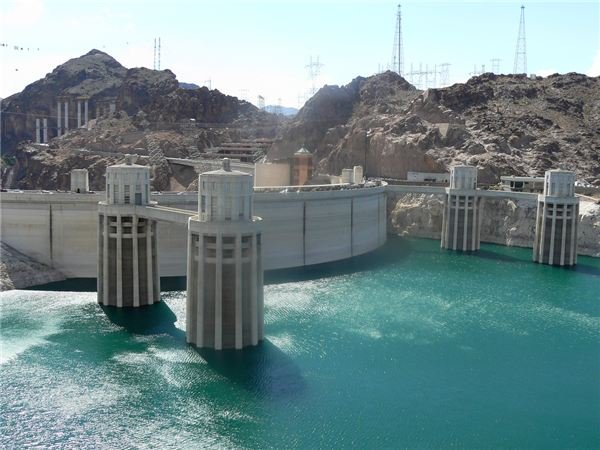
      • Lake Mead and Hoover Dam

        Lake Mead and Hoover Dam

        Lake Mead is the largest man-made resevior in the world. The construction of Hoover dam occurred between 1931 and 1936, the height of the American great depression. It was the crowning achievement of the era consisting of 2,480,000 cubic meters of concrete and holding back the flow of the mighty Colorado River. In addition to being both a hydroelectric power source and water reservoir, Lake Mead serves a third purpose as well- as a recreational lake. See "Five Interesting Facts about the Hoover Dam" for more information.
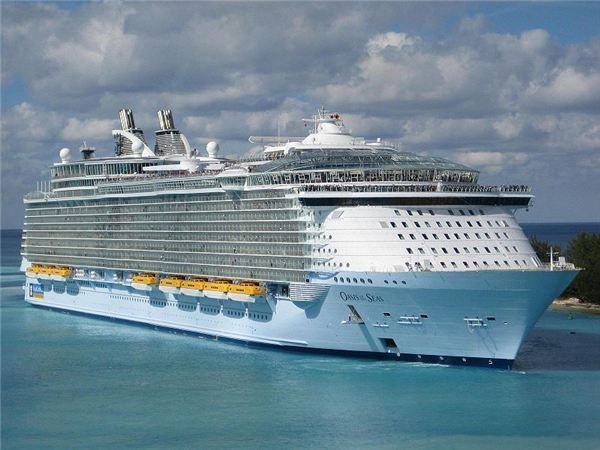
      • Oasis of the Seas

        Oasis of the Seas
        Called a city on the ocean, the Oasis of the Seas is one of two Oasis Class vessels in the world. With a displacement of 100,000 tons it comes in at the same weight as a American Nimitz aircraft carrier. It can handle over 6,000 passages and cruises in the Caribbean from a launch point in Ft. Lauderdale, Florida. It features a "living" park onboard that contains over 12,000 plants and over 50 trees as well as an entire boardwalk including a mini golf course and hand crafted carousel. If you're interested what the fuel consumption of these ships is like- and why it may not matter as much as one might guess- you might want to also see "Cruise Ship Gas Mileage" here at Bright Hub Engineering.